
Drawing the AI Line: Why Better Technology Still Requires Better Judgment

Aug 20
7 min read
Updated: Sep 10
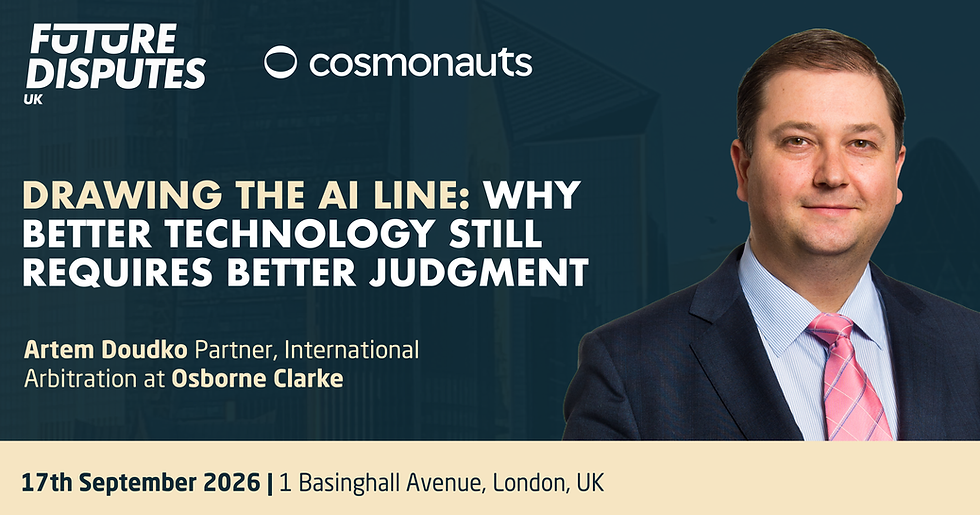
AI is transforming dispute resolution at remarkable speed. But as AI capabilities expand, one question becomes increasingly important: where should lawyers rely on technology, and where should human judgment remain firmly in control?
In this exclusive Q&A with Future Disputes UK, Artem Doudko, Partner, International Arbitration at Osborne Clarke shares his perspective on responsible AI adoption in high-stakes disputes.
Drawing on his experience in complex international arbitration and litigation, he reflects on the role of judgment, how technology is reshaping disputes practice, and why AI should support legal strategy rather than replace it.
Enjoy the interview below.
1. Over two decades in international arbitration, how has the day-to-day reality of running a matter changed with technology?
The transformation has been nothing short of dramatic. When I started out, everything was paper-based. Document volumes were a fraction of what they are today – we dealt in thousands of documents rather than the millions of emails that are now routinely exchanged in complex disputes. Hearings were always in person, pagination was done manually, and if you needed to reach someone urgently, you sent a fax. There was no working from home, no LinkedIn, no digital directories – you relied on hard copy publications and word of mouth to build your professional network and to select the best arbitrator and expert candidates.
Witness interviews were conducted over the phone, with notes taken by hand and later typed up by the fee earner or dictated to a PA using a dictaphone. Deadlines were set at 5pm, and turnarounds were governed by how quickly documentation could physically reach the other side. There was a special post service called DX, not sure if it still exists.
One year everyone at the firm where I was a trainee received Palm Pilots for Christmas, then the BlackBerry was introduced, these were significant game-changers. It was the first time you could be meaningfully connected outside the office, and it changed expectations around availability and response times. From that point on, the pace of change has accelerated with each successive wave of technology, from wider use of email and e-disclosure platforms, through to the mass adoption of virtual hearings during the pandemic and, most recently, the emergence of AI-assisted tools across the dispute lifecycle. What once took teams of people days (if not weeks) to process can now be completed in hours (if not minutes), and that shift has fundamentally altered how matters are staffed, budgeted and run.
2. Clients increasingly have access to the same outcome-prediction tools you do. How has that changed the conversation with clients, if at all?
It has certainly changed the dynamic. Clients increasingly come to us having already consulted outcome-prediction tools or AI-driven research platforms, which means they often arrive with a view (sometimes a confident one, sometimes a misplaced one, sometimes both) about the merits of their position. The challenge is that these tools tend to produce high-level summaries, and a high-level understanding can be more dangerous than no prior analysis at all if it instils a false sense of confidence.
The risk is not simply that AI tools can be wrong, it is that they can be partially right in a way that obscures what really matters. A tool might correctly identify that a contract is legally binding and enforceable, but fail to flag that the governing law clause points to a jurisdiction with materially different procedural rules, or that the dispute resolution clause requires mandatory mediation before arbitration can be commenced. These are not minor technicalities because they can fundamentally alter the strategy, the forum and the likely outcome of a dispute. AI is not truly reasoning through those interconnections in the way an experienced practitioner does; it is pattern-matching against prior data, and it does not know what it does not know. The more defined or self-contained the question, the more reliably it will perform. The more the answer depends on contextual judgment and the interplay between multiple legal and commercial factors, the greater the risk that something critical is missed.
That is where the experience and detailed knowledge of a specialist adviser remains indispensable: guiding clients from that initial high-level understanding to a clear and accurate assessment of where they actually stand.
The other area I expect to become increasingly significant is firm-specific AI configuration. Law firms are beginning to develop highly tailored prompt libraries, essentially institutional knowledge encoded into their AI systems, which will reflect the firm's collective expertise, sector knowledge and approach to particular types of dispute. These prompt libraries will become highly valuable assets, perhaps as significant as precedent banks are today, and protecting them will be a serious consideration for any firm that invests in developing them carefully. The firms that do so with rigour and consistency will have a meaningful competitive advantage.
3. In your experience, what separates a team that uses technology well in a dispute from one that just has the tools?
It can be the difference between winning and losing, particularly in the kinds of complex, high-value, cross-border disputes that we at Osborne Clarke handle. The distinguishing factor is not which tools a team has access to, but whether the team knows how to deploy them cohesively and strategically. Today every member of the team needs a baseline level of technological competence, but you also need genuine specialists, people who are champions of particular tools or prompt libraries in specific areas, whether that is document review, legal research, or chronology and timeline construction. Crucially, those specialists need to work together as an integrated unit, not in silos. The value of technology in dispute resolution comes from how the outputs of different tools are synthesised and applied, not from each tool operating in isolation.
That said, context matters enormously. In a straightforward dispute with a limited document set, the marginal value of sophisticated technology may be minimal. It is in the high-stakes, high-volume, multi-jurisdictional matters where the difference between a well-integrated technology strategy and a collection of disparate tools becomes most apparent.
There is also a real risk of overinvestment in technology for its own sake. The market is saturated, everyone is developing something, and the temptation is to acquire every available tool. But spending more does not automatically mean winning more. The discipline to select the right tools for the right matter, and to resist pressure to use technology simply because it is available, is itself a form of competitive advantage. Technology should serve the strategy, not the other way around. I will leave the question of cost for the client to a separate discussion, but will say that use of specialist technology involves a cost (sometimes substantial), good use of technology, should lead to efficiencies and cost savings.
4. How do you keep your own judgment sharp when more of the groundwork is being done by technology before it reaches you?
I think of it in a similar way to working with a talented junior. My role, and the role of other senior lawyers, is not to write the first draft, but we bring the strategic judgment and experience that elevates it. The role of technology, like the role of a good junior, is to handle the groundwork efficiently so that senior attention can be focused where it genuinely adds the most value. The risk, of course, is intellectual passivity, a tendency to accept outputs uncritically simply because they are produced quickly and presented with apparent authority. Keeping judgment sharp means maintaining a habit of interrogating what technology produces: asking whether the analysis reflects the full complexity of the situation, whether something important might have been missed, and whether the framing of the output is subtly shaping your conclusions before you have had a chance to form them independently. This is a particular concern with AI tools, which can produce fluent, confident-sounding analysis that nonetheless overlooks a critical nuance – the kind of nuance that a practitioner who genuinely understands the client's business, their commercial context, and the applicable legal landscape would immediately identify.
Staying close to developments in clients' markets and industries remains essential. Understanding what is commercially significant to a client, what risks they are exposed to and what outcomes actually matter to them cannot be replicated by technology, at least at present.
5. What's the one thing you'd like the audience to take away from your session at Future Disputes UK 2026?
The key message I would want the audience to take away is that dispute resolution is not a single road. It is a map and knowing which route to take can make an enormous difference to the outcome, the cost and the preservation of important commercial relationships.
When a risk materialises or a dispute is on the horizon, there is a spectrum of options available: negotiation, mediation, conciliation, expert determination, arbitration or litigation – and each has its own advantages, disadvantages and appropriate contexts. Businesses and in-house teams who default to a single approach, often arbitration or litigation simply because that is what their contracts provide, or because it is what they have always done, may be missing options that are faster, more cost-effective or better suited to the situation.
The instinct to follow precedent is understandable, but it can be costly. A dispute resolution clause may have been drafted years ago for a very different commercial context, and it is always worth asking whether it still reflects the most appropriate mechanism for the dispute at hand.
My strong advice is to talk to a specialist early when a potential dispute is brewing, before positions have hardened and before the cost and disruption to the business of formal proceedings has been incurred. Early, informed advice on the right forum and the right process can be invaluable, both in terms of outcome and protecting the resources and relationships that matter most to the business.
Artem's insights highlight that success in modern dispute resolution isn't determined by how many AI tools a team adopts, but by how deliberately those tools are integrated into legal strategy. Technology can accelerate the work, but judgment, context, and experience remain the factors that shape the outcome.
Artem will join the panel "The AI Line: What Disputes Professionals Should and Shouldn't Use" this 17th September, where he will discuss how disputes teams can balance efficiency with confidentiality, accuracy, privilege, regulation, and accountability as AI becomes embedded across legal practice.
Register now to join the discussion at Future Disputes UK.



Comments